
Scenic Sailing Along Rhine Gorge
July 1, 2026
The boat left Rüdesheim just after breakfast. Sailing between Rüdesheim and Koblenz, the Rhine narrows into a gorge flanked by (reportedly) more than 40 castles and fortresses. The cruise director narrated the journey, and the photos on this page capture most of the castles we saw, which were fewer than 20 (perhaps some are only ruins that were not visible from the river). Most of these castles were built between the 12th and 14th centuries by local lords who taxed passing river traffic. This 65-kilometer stretch has been a UNESCO World Heritage Site since 2002.
Along both banks of the river, terraced vineyards climb the hillsides, mostly producing Riesling, which has anchored the regional economy for centuries. Between the vineyards are quaint and scenic German towns, some with very ornate churches, which also appear in the photo collection below.
Click on the photos below to enlarge.
Burg Reichenstein Rüdesheim

Robber knights ruled here until Rudolf of Habsburg's 1282 siege; rebuilt as a neo-Gothic castle in 1902.
St Martin Church

Built in 1270, this Gothic church houses Germany's largest and oldest wood-carved altar, dating to 1483.
Stahleck & Half-Round Tower

To the lower left of the castle, Half-Round Tower is one of 16 surviving towers in Bacharach's town wall, begun in 1344.
Burg Schönburg

Burned by the French in 1689 and left in ruins for 200 years; restored by an American family starting in 1885.
Kuhhirtenturm Tower

A 'cowherd's tower' in Oberwesel's town wall, once used to herd cattle out to pasture each morning.
Burg Katz

Built in 1371 by Count Wilhelm II of Katzenelnbogen; nicknamed 'Cat' in rivalry with nearby Castle Maus.
Burg Maus

Built by the Archbishop of Trier to rival Burg Katz across the valley, earning the nickname 'Mouse.'
St Nikolaus Parish

Built in 1902-1904 in Neo-Romanesque style, this Catholic church sits just below the 'Hostile Brothers' castles.
St Margaretha Church

Built in 1897 in Neo-Gothic style, this Catholic church now doubles as a rest stop for cyclists on the Rhine trail.
Sooneck Castle

Destroyed in 1282 by Rudolf of Habsburg, this ruin was rebuilt in 1834 as a Prussian princes' hunting lodge.
Fürstenberg Castle Ruins

Built in 1219 by the Archbishop of Cologne to collect Rhine tolls; destroyed by the French in 1689, never rebuilt.
Pfalzgrafenstein Castle

Built in 1327 as a toll castle on a Rhine island; the only Rhine castle never conquered or destroyed.
Liebfrauenkirche Church

This Gothic church, built 1308-1351, holds a golden altar and is nicknamed the 'red church' for its walls.
St Martin's Church

Built around 1350, this Catholic church's white stone gives it the nickname 'White Church.' (in the background)
St Johannes Church

Built in 1923–1925 by architects Hans and Christoph Rummel, this Catholic church sits in the UNESCO Rhine Valley.
Burg Sterrenberg

Legend has it that the two brothers (the Hostile Brothers) loved the same woman and grew up in this castle before one left.
St Severus Basilica

Built over Roman baths in the 12th-13th centuries; named a basilica minor by Pope Leo XIII in 1903.
Marksburg Castle

The only Rhine castle never destroyed; it's been continuously inhabited for over 700 years.
Heimburg Niederheimbach
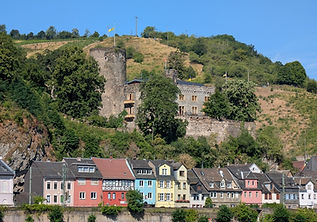
Built 1294-1305 by the Archbishop of Mainz; rebuilt in the 1800s by industrialist Hugo Stinnes.
Stahleck Castle

First documented in 1135, this castle was destroyed by the French in 1689 and later rebuilt as a youth hostel in 1925.
Burg Gutenfels

Built around 1220; survived a 1504 siege, earning the name 'Gutenfels' (solid rock). Now a castle hotel.
Schönburg Castle Two

Since 1957 the Huttl family has run this rebuilt castle as a hotel, on a lease now in its third generation.
Katzenturm Martinskirche

Part of Oberwesel's medieval wall; 16 of its original defensive towers still survive today. Plus, another view of St. Martin's.
Rheinfels Castle Hotel

Perched on the hill to the right. Built in 1245, this was once the largest fortress on the Middle Rhine; part of it is now a hotel.
Burg Liebenstein

The jilted brother built this castle and a dividing wall (Quarrel Wall) after his sibling returned from the Crusades with a foreign bride.
Villa Belgrano

Built in 1891 for a Boppard native who'd emigrated to Argentina, named after his Buenos Aires neighborhood.
Stolzenfels Palace

Rebuilt 1836-1842 for Prussia's crown prince in Gothic Revival style, designed by Karl Schinkel.