
Third Day: The Morning in Speyer and Evening in Rüdesheim
June 30, 2026
After overnight cruising, our third stop was Speyer, where we took a morning walking tour of a historic section. Speyer was founded around a Roman fort in the 1st century CE. Speyer Cathedral, founded in 1030 by Emperor Conrad II and completed about 80 years later, is the town's most prominent building. It was gutted by French troops in 1689 and rebuilt several times, most recently consecrated in 1961. A few blocks away is Trinity Church (1701-17), built in the Baroque style. The Altpörtel (Old Gate) tower, part of medieval defenses, was built in the 13th century. Our tour also included the early 12th-century underground Jewish Mikveh in the old Jewish quarter, though we couldn't go underground.
Our boat arrived in Rüdesheim in the late afternoon. The earliest known written record of Rüdesheim dates back to 864. The town features half-timbered houses, narrow streets, a market square, and historic inns, all contributing to its medieval charm. Situated in one of Germany's top wine regions, vineyards cover the steep hillsides directly above and around the town. Taverns developed in town as outlets for local wine, especially along Drosselgasse, a pedestrian street lined with wine taverns and bars that offer live music and sing-alongs, making it popular with tourists.
The photos on this page document Speyer, a few sights along the Rhine, followed by a few images of Rüdesheim.
Click on the photos below to enlarge.
Speyer Cathedral South Transept
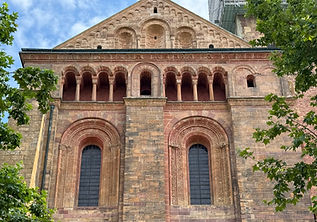
Founded in 1030 by Emperor Conrad II, this is the world's largest Romanesque church, UNESCO-listed since 1981.
Gasthaus zum Domnapf Speyer
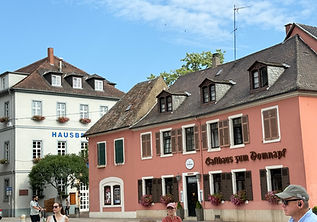
Named for the Domnapf, a 1,580-liter stone bowl once filled with free wine for citizens whenever a new bishop was installed.
Zunftbaum Guild Tree
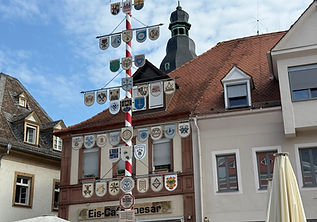
This 'Zunftbaum' is a year-round version of a Maypole, its shields honoring local craft guilds like masons, bakers, and tailors.
Mainz-Hechtsheim Church

Its 1200s tower is the only part to survive a 1752 rebuild; the church flipped Catholic and Protestant four times.
Johannisberg Palace

In 1775, a delayed courier let grapes over-ripen; the result accidentally invented Germany's 'late harvest' Spatlese wine.
Oberstrasse Rüdesheim

Six narrow lanes, including the famous Drosselgasse, descend from this street down to the Rhine, a layout dating back centuries.
Speyer Cathedral Westwork
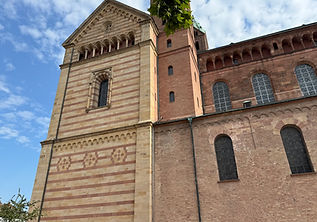
Rebuilt 1854-58 by Heinrich Hubsch in Neo-Romanesque style, its red-and-yellow stone stripes are the cathedral's signature.
Historisches Museum der Pfalz
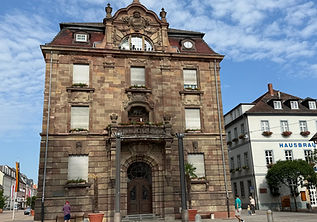
Built in 1910, this museum holds the Speyer wine bottle, dating to around 325 AD, the world's oldest unopened bottle of wine.
Speyer Cathedral West Facade
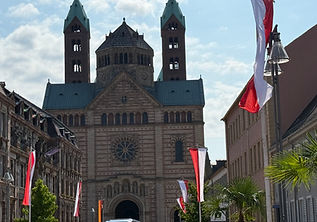
Rebuilt 1854-58 under King Ludwig I of Bavaria, this facade sits at the end of Maximilianstrasse, Speyer's main avenue.
Mainz Cathedral

Founded in 975, this cathedral burned down on the very day of its 1009 consecration; it has caught fire six more times since.
Kempton am Rhein

The Romans called this village 'Caput Montis'; legend says the Three Kings' relics rested here overnight en route to Cologne.
Kumenstrasse Rüdesheim

Many of Rüdesheim's white-facade houses feature wood beams filled with wattle-and-daub, then plastered and painted white.
Speyer Cathedral Demon Relief

Added during the 1850s reconstruction by sculptor Gottfried Renn, this demon warded off evil spirits from the sacred threshold.
Dreifaltigkeitskirche Speyer
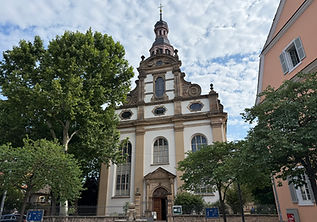
Built 1701-1717, this was the first civic church rebuilt after 1689; its original painted wooden ceiling survives intact.
Speyerer Schuh
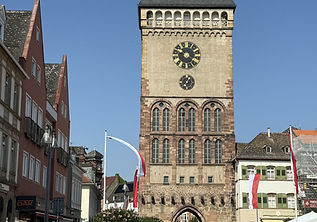
This tower served as Speyer's main western city gate, defensive watchtower, and a bell tower to signal daily curfews and fire alarms.
Biebrich Palace

What began in 1700 as a simple garden shed grew into this Baroque palace, nicknamed the 'Versailles on the Rhine.'
St Hildegard's Abbey

Founded in 1165 by Hildegard of Bingen, the Gestapo expelled its nuns in 1941; they returned in 1945, its founding anniversary.
St Jakobus Church Rüdesheim

Dating to the 10th century, this church was destroyed by WWII bombing and took nine years, until 1956, to rebuild.