


Appendix: Special Topics-Loudness
This page offers more detail on a couple of home theater design topics summarized in the previous theater build pages. Topics on this page include more information on Speaker Volume Estimation and Subwoofer Size/Volume estimation. I worked through each of these topics myself with some help from the internet. If you find any mistakes, let me know by sending a comment.
Speaker Volume at the Listening Position
Last Updated: 02/24/2026
Typical listening volume is a matter of personal preference. Still, a maximum volume level system requirement needs to be defined to ensure that the audio system can play loud enough for its occupants. Several industry specifications define average and maximum listening volume, which can be used as guidelines for developing a home theater design goal. Some enthusiasts answer this question by ensuring their system can operate at full "reference volume." According to THX and Dolby specifications (and the DCI Digital Cinema System Specification), the calibrated reference levels for a cinema or home theater are 85 dB SPL average and 105 dB SPL peak per full-range channel. The LFE channel is generally specified at 95 dB average and 115 dB peak. (Note: Typical audio calibration tools use 75dB reference signals and scales internally.) Arguably, many "experts" think that these levels are too loud for a typical small home theater and recommend targeting levels about 10dB lower. (See Table 2 at the very end of this section for more information on the detailed specifications.)
For this room, since I generally listen to movies, TV, or music at an average volume of around 75dB (with multiple speakers), I decided to relax the volume goal to 75-80dB average and 95-100dB peak. So, this matches targeting levels, which are about 10dB lower than the specifications.
So, how can one determine if the design meets this goal? Especially when we don't have the tools (or are too lazy) to do a detailed simulation of the room. One can get a reasonably good estimate from a few basic equations and some estimates of the room's gain/loss contribution.
Speaker Sensitivity—This specifies how loud a speaker is at 1 m. See Figure 4. However, there are a couple of caveats because different manufacturers may measure speaker sensitivity differently.
-
There are two ways manufacturers specify this. The original test method applies a 1-watt signal to the speaker and measures the audio level 1 meter from the speaker. The more recent methodology is the same, except that a 2.83-Volt signal is applied to the speaker, which for an 8Ω speaker is equivalent to 1-Watt. However, if the speaker's nominal impedance is not 8Ω, the input power differs, and the sensitivity specification needs to be adjusted.
-
The equations assume this specification does not include boundary reinforcement (or room gain). Room gain (aka room reinforcement) will reduce energy loss, and adjustments are needed to account for it.
Seating Distance—The distance the listener is sitting away from the speaker. If we know the listener's seating distance and speaker sensitivity, we can determine the expected volume at our seat.
Amplifier Gain—Normally, we power speakers with more than 1 watt, so this is the amplifier's gain above the reference level. See equation 3 below.
Room Reinforcement—The equations below are based on an anechoic room (no reflections). In an actual room, reflections reduce sound loss. To determine this exact amount, detailed modeling is required. However, there are some published approximations, which I used to compensate for this. For a small room, the loss reduction is about 3-6 dB.

Figure 4. Picture showing speaker and distance to listener
Using the above, the basic equation for SPL at the listener's position is:
The loss is due to distance from the speaker. Assumes no room reinforcement and a single speaker.
Gain due to Amplifier:
The full equation becomes this:


Distance (ft) | Distance (m) | SPL Loss |
|---|---|---|
3.28 | 1 | 0 |
4 | 1.22 | 1.7 |
5 | 1.52 | 3.7 |
6 | 1.83 | 5.2 |
6.56 | 2 | 6 |
7 | 2.13 | 6.6 |
8 | 2.44 | 7.7 |
9 | 2.74 | 8.8 |
9.84 | 3 | 9.5 |
10 | 3.05 | 9.7 |
11 | 3.35 | 10.5 |
12 | 3.66 | 11.3 |
Amplifier Power (W) | Amplifier Gain (dB) (1W Reference) |
|---|---|
200 | 23.01 |
150 | 21.76 |
100 | 20 |
80 | 19.03 |
40 | 16.02 |
20 | 13.01 |
10 | 10 |
5 | 6.99 |
2 | 3.01 |
1 | 0 |
Table 1. Ideal SPL loss (left) and amplifier gain (right)
Using equation 4, even without knowing which speaker will be chosen, I could estimate the sound volume for this theater. We can use some typical numbers to give a general idea of what is possible.
-
A typical number for a bookshelf speaker's sensitivity is ~85dB.
-
A typical value for amplifier power is 100W per channel.
-
For this home theater, the listening distance is ~12ft or 3.66 meters.
Substituting these values into the equation results in:
Assuming no room reinforcement, the calculation results in an SPL of 94 dB. The estimated impact of room reinforcement is a 4-6 dB gain at the listening position, which results in a 98-100dB maximum SPL. Even though these design assumptions don't meet peak reference SPL specifications, reaching ~100dB is not quite full reference volume, but it is acceptably loud to me.
Table 1 shows SPL losses for a range of seating distances and amplifier gains, expressed in dB. These show the difference distance and amplifier power can make.
Some additional informative links on room audio volume considerations:

More on Speaker Sensitivity
Some clarification is needed regarding the sensitivity measurement. Using 1 Watt as the input power is convenient because it makes it easy to adjust the audio level based on the power supplied by an amplifier, as shown above. However, when using a fixed voltage, you must consider the power differences across various loads. The lower the impedance, the more power is delivered. To illustrate this, refer to the equations below. Equation #5 shows the basic power formula in terms of applied voltage and speaker impedance. Rearranging and solving for voltage (Equation 6), we see that to deliver 1 Watt to an 8Ω speaker, you need to apply 2.83V. Applying this 2.83V to a 4Ω speaker results in supplying 2 Watts (equation 8).
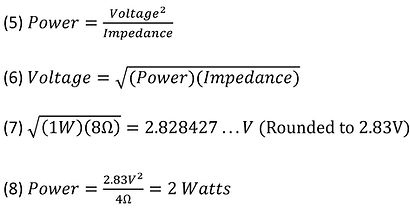
or a 4Ω speaker specified with a 2.83V input, the sensitivity is adjusted to find the 1-Watt sensitivity. Equation #3 can be used for this calculation, which shows that the sensitivity decreases by 3dB, since 10log(2) = 3. For example, a 4Ω speaker with a sensitivity of 85dB with a 2.83V test signal will have an 82dB sensitivity at 1-Watt input.
Even after doing these calculations, it is important to remember that the results are very approximate due to several factors. First, none of these equations accounts for room gain. Second, a manufacturer's speaker impedance specification is approximate and is rarely exactly 4 or 8 Ω.

Table 2. Home Theater and Cinema Reference Level Specifications.
Note 1: SMPTE specifications require purchase, so this information is based on other websites which reference these specifications.
Note 2: The THX Standards are limited to professional access of this information is based on other websites which reference these specifications
Estimating the Desired Subwoofer Loudness
Last Updated: 02/20/2026
When selecting a subwoofer for the home theater, the two main requirements are (1) the subwoofer's frequency range and (2) the subwoofer's output capability (volume) across the frequency range. When selecting a subwoofer for a home theater, it is important to confirm that it meets the room's requirements.
For the loudness requirement, I needed to decide on a goal. For the same reasons mentioned at the beginning of the Speaker Volume section, define a target loudness that the home theater (specifically, in this case, the subwoofer) should meet. As also stated in Table 2 of the previous section, various industry specifications define the average and peak reference levels that cinemas and home theaters should be designed to meet. This informs the loudness goal. For the LFE channel, the general reference target is a continuous/peak of 85/115 dB. Also, as stated previously, this reference level is too loud (my opinion) for a small home theater, and a more reasonable target is 10dB lower than the cinema specifications, i.e., 85dB continuous and 105dB peak SPL.
Typically, the easiest way to determine whether a particular subwoofer can play loud enough for the room is to look at reviews that include measurements. Some websites and YouTube channels provide measurements or in-room estimates. For example, for the (now very old) SB12-NSD subwoofer used in my home theater, Audioholics.com not only provided measurements but also included room-size recommendations in their review, which was based on their estimation methodology (see HERE).
If reviews don't directly provide this information, it is possible to extrapolate it to determine whether a specific subwoofer can play loud enough in one's home theater. The process is markedly different from that of normal speakers. These differences need to be accounted for when making an in-room estimate.
-
Since subwoofers almost always integrate the amplifier, instead of using speaker sensitivity, subwoofers are measured as a system to determine their loudness, which CEA 2010 tests do directly.
-
In many instances, more than one subwoofer is used to smooth the room response and should be included.
-
In a typical small home theater room, bass frequencies whose half wavelength is shorter than the room's longest dimension do not follow the inverse-square law distance losses. This behavior is sometimes called room gain.
ANSI specifications CEA 2010-A and CEA 2010-B define a standard test methodology for measuring subwoofer loudness. If these measurements are available, one can use them to determine (approximately) whether a specific subwoofer meets the in-room loudness design goals for a given enclosed theater room. As an example of CEA 2010 test results, Table 1 shows measurements for the SB-12NSD.

Table 1. CEA2010 Measurements for SVS SB12-NSD
(Data extracted from Audioholics Review, and Data-Bass)
A Method to Estimate Subwoofers In-Room Loudness
If CEA 2010 measurement data are available, the in-room design requirement can be converted to match the CEA 2010 test conditions and compared with the CEA 2010 measurement to determine whether a specific subwoofer can produce the desired in-room loudness. The following describes a method that I have used. (Disclaimer: This estimation process has not been validated via actual in-room measurements. However, going through the process was somewhat educational. At the end of this article, two other estimation techniques are briefly discussed.)
-
First, select the in-room peak loudness goal. As stated above, many specifications define 115dB for LFE, but for this room, 105dB was chosen.
-
Second, we need to start with some test data. CEA 2010 contains a couple of different tests. The most commonly used in reviews is the 2-meter ground-plane RMS test. Each test can be run at various frequencies between 12.5 and 160 Hz. The most relevant frequencies for this estimation are 20/25/31.5 Hz. I chose 31.5 Hz because (I believe) there is typically little audio information below that frequency in movies and music. 20 Hz is another possible choice. It should be used if the requirement is for the subwoofer to play flat to 20 Hz, but it is more expensive to meet than 31.5 Hz.
-
Next, we'll convert the desired in-room target loudness to the equivalent conditions of the CEA 2010 test. If the subwoofer's CEA 2010-measured loudness exceeds the adjusted in-room target loudness, the subwoofer meets the required loudness.
-
There are 4 adjustments to the in-room target volume. These are:
-
Room Gain: In the bass region (20Hz to 80Hz), Room Gain (aka Pressurization) increases bass loudness in smaller rooms. Without going into the physics of low frequencies, the subwoofer's energy stays within the room, effectively "amplifying" its output. Since CEA 2010 measurements are taken in an open field, translating the in-room response needs to account for this effect.
-
Distance Loss: This is the same behavior as with speakers. The further away one sits, the lower the volume. In smaller rooms, we will be sitting closer to the subwoofer, so there is less loss. In larger rooms, the inverse-square law (Distance Loss) tends to a bigger factor. The CEA 2010 measurement conditions use a 2m distance, so again an adjustment to the in-room goal is needed to correlate the loudness.
-
Boundary Gain: The CEA 2010 test conditions define a single ground plane test in an open area. When a subwoofer is placed against a wall or in a corner, the sound is reflected into the room, increasing the volume (compared to the test data). This is called Boundary Gain. Mid-wall placement results in a theoretical 6 dB gain, and corner placement results in a theoretical 12dB gain. In reality, the gain is a couple of dB lower since rooms are never perfect.
-
RMS to Peak Conversion: The CEA 2010 test data that is being used is an RMS test, but this estimate is for peak loudness; thus, this estimate needs to account for the 3 dB difference.
-
-
What we want to do is take the in-room target loudness (e.g., 105 dB) and subtract the various audio gains and losses to determine the subwoofer's volume under the CEA test conditions. In other words, we are translating the desired volume/loudness in a theater room to how loud the subwoofer would measure under CEA 2010 test conditions. Then we can compare this translated target value to the CEA 2010 measurements for a specific subwoofer; if the CEA measurements are louder (higher dB), that subwoofer can meet or exceed the in-room target.
Boiling all the above factors into a single equation results in the following:

Originally, this analysis was done for the room described on this website, but since then, the list of room sizes has been expanded, drawing from the room size definitions used by Audioholics.com.
-
Small Rooms (< 1,500 cu. ft.)
-
Medium Rooms (1,500–3,000 cu. ft.)
-
Large Rooms (3,000–5,000 cu. ft.)
-
Very Large Rooms (> 5,000 cu. ft.)
Then, for each room size, estimates were made for each of the four gain/loss parameters in the above equation.
-
InRmTarget - This is the target loudness goal for the subwoofer in the room. This value is the same for all room sizes. As stated previously, I used 105dB. A worst-case value would be to use 115dB.
-
RoomGain - There are two ways to look at this value. One view is to use the room's volume as a reference. A doubling or halving of the volume changes the bass energy in the room by 6 dB. The very large room is assumed to have 0 dB gain; for large rooms, the base is boosted by 3 dB; for medium rooms, 6 dB; and for small rooms, 12 dB. A second method is to use the pressurization frequency, i.e., the frequency whose wavelength is twice the room's length, and scale the gain accordingly, which yields results similar to the first method.
-
DistLoss - The distance loss is the loudness (inverse square) loss due to the listener sitting more than 2 meters away from the subwoofer. For very large and large rooms, the listener distance is assumed to be 4 m, which results in a 6 dB loss. In the small room, the listening distance is assumed to be 2 meters, so 0 dB loss; in the medium room, it's in between, so 3 dB.
-
BndyGain - It is assumed that the subwoofer is placed at a mid-wall location. This is treated as constant across room sizes, and since rooms are never perfect, this estimate uses 4 dB instead of 6 dB as stated above. If the subwoofer were placed in a corner, then (in theory) 12 dB or a little less could be justified.
-
RMSConv - As previously stated, this is the conversion between RMS and Peak, so all rooms use the same 3dB.
Table 2 consolidates the above information. The rightmost column lists the target CEA 2010 31.5Hz test results that a subwoofer needs to output to hit the target shown in the second-from-the-left column. The SB 12-NSD measures 101 dB at 31.5Hz and thus meets the requirement for a medium-sized room. However, if the requirement were to meet the 105 dB target at 20 Hz or the 115 dB target, this subwoofer would not be powerful enough, and its low-frequency roll-off would start a bit too high for the tighter requirement.
This table has not been verified by measuring subwoofers in the room, so its accuracy in the real world is debatable.
Finally, a fair criticism of the loudness goals used here is that they are not chosen to yield a perfectly flat robust bass down to 20 Hz, and many bass enthusiasts strongly target achieving a flat response into the mid-teens. Furthermore, another valid criticism is that a full cinema reference volume was not the goal here. With the described methodology to address these two criticisms, one needs only change the in-room target (InRmTarget), which will add 10 dB to the 2mGPTarget column in Table 2, and use the CEA 2010 20Hz data point for the selected subwoofer.

Table 2. Subwoofer Loudness Estimation
Note 1: In Small rooms, pressurization eliminates distance-based attenuation at 31.5 Hz.
Note 2: In Medium rooms, partial pressurization slows the attenuation rate.
Note 3: In actuality Room Gain is a Slope that begins at the room's pressurization frequency and increases as frequency goes down. Smaller rooms have a higher pressurization frequence, so there is more "room" for the gain to build up by the measurement point (31.5 Hz). Large rooms have a lower pressurization frequency (below 31.5 Hz) thus there is 0 dB of help at 31.5 Hz or 40 Hz. The table values approximate this by reducing room gain as room size increases.
Note 4: Adding a second subwoofer is estimated to add +3 dB to the output level. This assumes placement of two subwoofers on opposing walls. Co-locating the subwoofers changes this increase to +6dB. This lowers the target number by either 3 dB or 6 dB.
Other Loudness Estimation Methods
There are a couple of websites that also describe methods for estimating, so it seems reasonable to mention them here. The first is Audioholics.com, which has a nice description (HERE) of how they arrived at their approach. The differences in the gain/loss items are:
-
A fixed listening distance of 4 m is used for all room sizes. Distance Loss is -6 dB for all room sizes.
-
Corner placement is assumed. Corner loading (+12 dB) is the same for all room sizes.
-
The reference level is 115 dB, except for the very large room, which uses 123 dB.
-
There is a room-size-dependent gain: +12 dB for small rooms, +6 dB for medium rooms, and 0 dB for large rooms.
-
The room gain is subtracted from the original in-room target to obtain a room-gain-adjusted in-room target.
-
The Distance Loss, Boundary Gain, and RMS-Peak conversion, totaling 9 dB, is added to the subwoofer's CEA 2010 measurement at 31.5 Hz.
-
The adjusted in-room target (#5) is compared to the adjusted subwoofer CEA measurement.
-
There is one additional criterion: a subwoofer's 25 Hz CEA measurement must be less than 6 dB below its 31.5 Hz measurement.
The Audioholics estimation method uses the same four adjustments (Room Size/Gain, Distance Loss, Boundary Gain, and RMS to Peak) but combines them differently. The four adjustments are derived slightly differently and thus have different values. Table 3 tabulates the parameters and specific values used in the Audioholics estimate.

Table 3. Audioholics In-Room Loudness Methodology
(Based on information from Audioholics' Bassaholic Subwoofer Room Size Rating Protocol)
Since Audioholics' estimate relies on similar losses and gains to those in the previous estimate, the values in Table 3 can be used to create the equivalent adjusted 2m ground-plane and in-room target, as before. The results are shown in the blue shaded column in Table 3.
Another subwoofer loudness estimation method is listed in a thread on AVForums (HERE). This uses a similar methodology to Audioholics and many of the same values for Distance Loss, Boundary Gain, RMS-to-Peak Conversion. It uses a similar Room Gain/Size, except that it breaks the room into 12 different sizes. The biggest difference is that this approach uses the 20 Hz CEA 2010 data point, which is, of course, more difficult for subwoofers to reproduce and therefore make this a more pessimistic estimation.
Sources for Subwoofer CEA-2010 Measurements
Below is a list of websites that provide subwoofer measurement data.
-
Data-Bass: Subwoofer Measurements
-
Audio Science Review (Thread): Subwoofer Comparison
-
AV Forums (Thread): How much subwoofer output capability do you need in your system?
-
Data-Bass: Subwoofer Measurements
-
Erin's Audio Corner: CEA-2010 Subwoofer Testing