
Gettysburg Historical Touring
Working on some description of our visit.
Click on an image to pop up a larger version.
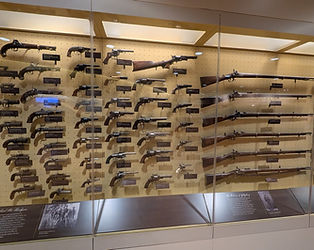
Civil War Era Firearms Display
This display, which is located in front of the Cyclorama entrance, showcases a variety of firearms used during the American Civil War. It includes pistols, carbines, and rifles. The display features weapons with various firing systems, including flintlock, percussion cap, and early breechloaders. Notable firearms on display include the Colt Navy revolver, the Sharps carbine, and the Springfield rifle musket. Revolvers became common for cavalry and officers. Carbines, being shorter, were favored by mounted troops. The collection highlights the shift from handcrafted to mass-produced weapons, increasing availability, and transforming military tactics.

Now, Boys, Lie Low
This display focuses on the personal story of Private Daniel Riegle, a 20-year-old Union soldier who fought with the 87th Pennsylvania Infantry. It includes his uniform, letters, a revolver, personal items, and wartime photographs. The handwritten letters offer firsthand accounts of combat and daily life, including Riegle's participation in battles such as Petersburg. A bullet-pierced canteen and other battlefield relics highlight the harsh conditions faced by soldiers.
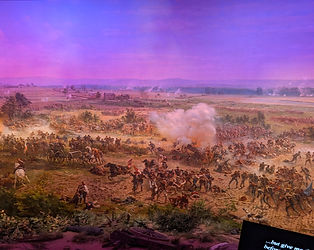
Cyclorama: Thunder of Artillery
This section captures the intense artillery bombardment that preceded Pickett's Charge, with cannon smoke billowing across the battlefield and muzzle flashes illuminating the scene. One can see Union and Confederate artillery units positioned across the rolling countryside, actively engaged in a barrage of cannon fire.

Union Soldier’s Standard Field Kit
This exhibit displays a typical Union infantryman's uniform and gear used during the Civil War. The exhibit features a dark blue wool frock coat, light blue trousers, a "U.S." belt plate, a wool blanket, a tin cup, and a Model 1861 Springfield rifled musket, the standard-issue firearm for Union forces. The exhibit also notes how Union soldiers became more uniformly equipped by the second year of the war, despite continued shortages.

12-Pounder Napoleon Cannon
The cannon in the photo is a Model 1857 12-pounder Napoleon, the most widely used smoothbore artillery piece during the American Civil War. Named after French Emperor Napoleon III, this bronze cannon was favored by both Union and Confederate armies for its reliability, versatility, and firepower. It could fire solid shot, shell, case shot, and canister rounds, making it effective against both troops and fortifications. It had a maximum range of about 1,600 yards and was typically served by a crew of six to eight men.
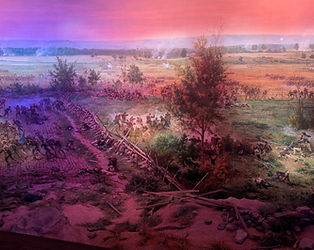
Cycloroma: The Bloody Climax
This section of the Gettysburg Cyclorama depicts the intense fighting during Pickett's Charge, with the dramatic purple and pink lighting effects emphasizing the chaos and carnage of the battle. You can see fallen soldiers, broken fence rails, and the scattered debris of combat across the foreground, while troops continue fighting in the background.

Civil War Soldier's Campsite
This display shows a typical Civil War military camp scene. It includes Weapons that are stacked in the center using the tripod method. Standard camp gear is present: crates, lanterns, cookware, and writing materials. Officers had better supplies, a larger wall tent, and furniture, as seen in the right section. Enlisted soldiers had smaller tents and often slept on the ground with only a blanket.

Cycloroma: Fury of Pickett's Charge
These and the following photos are a few (of many) shots of the Gettysburg Cyclorama. It is a 377-foot-long, 42-foot-high panoramic painting that forms a 360-degree circular viewing experience, depicting Pickett's Charge, the Confederate assault on the third day of the Battle of Gettysburg (July 3, 1863). It was painted between 1883 and 1884. It was based on extensive research that included visits to the battlefield, photographs, maps, and interviews. The finished work debuted in Chicago in 1884 as immersive entertainment that surrounded viewers. This circular mural was a popular 19th-century visual medium that predates the advent of cinema.

Cycloroma: Battle's Aftermath
Today, the Cyclorama has been fully restored and enhanced with modern features. The mural completely encircles the central visitor area, a circular, raised platform. In front of and below the painting are three-dimensional foreground dioramas. During the presentation, lighting effects and sound design simulate the sounds of cannon fire and troop movements. The immersive display recreates the intensity of Pickett's Charge, placing the audience at the center of the action.