
Gettysburg Historical Touring
Working on some description of our visit.
Click on an image to pop up a larger version.

Jennie Wade Statue
The building was a duplex. The north-facing residence was the McClellan-owned home, and Catharine McClain owned the south-facing part. The house was directly in the line of fire from the Confederate troops coming from the north and attacking Cemetery Hill to the south.
(Click on the photo to see all of the statue.)

McClellan's Front Door
Jennie was struck by a stray bullet (likely a Minié ball, conical shape with a hollow base) that passed through the north-facing door (shown in photo) of the McClellan while she was kneading dough in the kitchen. Expand the photo to see the full original door with several bullet holes visible.)

Basement Painting on Display
This painting, displayed in the basement of the Jennie Wade House, portrays the McClellan family and a Union soldier gathered around Jennie’s body after her death. It shows Georgia McClellan holding her newborn child while two soldiers stand by. The figure lying beneath the quilt on the cot is Jennie Wade. Her body was likely moved to the basement for protection from ongoing gunfire.

Georgia's Parlor Bedroom
Georgia was expecting, so her bed was set up in the downstairs parlor. Her husband, who was away fighting, wanted her to be more comfortable. The kitchen was located next to the parlor, where the family, particularly Jennie, would supply food and water to the soldiers.

Upstairs Bedroom
In one of the upstairs bedrooms, a cannon shell hit on July 2, 1863, the second day of the battle. It entered through the brick wall and embedded itself in the bedroom wall (likely Georgia McClellan's room), without detonating. This can be seen on the lower left of the photo. A replica of the cannon shell has been placed in the room to illustrate where the shell ended up. The impact caused minor structural damage but did not injure any of the occupants. Despite the near-miss, Jennie Wade, her mother, and Georgia remained in the house to care for Georgia's newborn child.

The Unexploded Cannon Shell
This image is the original cannon shell taken from the second floor of one of the upstairs bedrooms. The cannon shell is likely a 10‑pound Parrott artillery shell, fired during the intense bombardment on July 2, 1863. These shells carried explosive black powder, which was triggered by a percussion or time fuse.

McClellan Kitchen
Unlike other Gettysburg residents who mainly hid in their basements, Jennie and her sister's family continued to live in their main house, taking care of her sister's baby and being very patriotic, supporting the Union troops by providing water and baking bread.
This is a photo of the first-floor kitchen area, where Jennie was reportedly baking bread when a bullet (one of several) came through the front door (not in the photo) and struck Jennie.
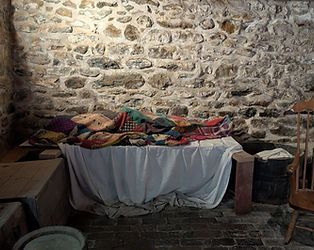
The Basement
One side of the basement is set up as it would have been after Jennie had died and was moved down to the basement.