
Gettysburg Historical Touring
Working on some description of our visit.
Click on an image to pop up a larger version.

McPherson's Barn
The McPherson Farm and Barn are located on McPherson Ridge northwest of Gettysburg's town center. The farm was the scene of heavy fighting on the first day of battle as Confederate General Henry Heth's Division advanced towards Gettysburg against General John Buford's defending Union cavalry. During the intense combat that swirled around the property, many Union soldiers took refuge in the large barn. After Confederate forces captured it, it was used as a field hospital. The barn continued to serve as a hospital long after the battle ended, providing care for the wounded from both sides. McPherson's Barn was the scene of the opening moments of the fight and also a symbol of the humanitarian efforts afterward.

The Eternal Light Peace Memorial
The Eternal Light Peace Memorial symbolizes national reconciliation and unity between North and South following the Civil War. Dedicated on July 3, 1938, and marking the 75th anniversary of the Battle of Gettysburg, the monument was unveiled during the last major reunion of Union and Confederate veterans. The granite and limestone structure bears a continuously burning flame atop its tower, representing the enduring hope for peace. It was erected on Oak Hill, where some of the battle's heaviest fighting occurred.
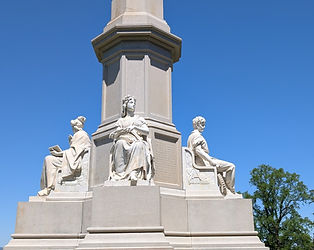
Soldiers' National Monument at Gettysburg
This monument is the Soldiers' National Monument, located in the Gettysburg National Cemetery. It is the centerpiece of the cemetery. Dedicated on July 1, 1869, the monument honors the Union soldiers who fought and died in the Battle of Gettysburg, a turning point in the American Civil War.
The monument features several allegorical figures. At the top stands the figure of Liberty, holding a sword and a wreath. Below her, four seated figures represent War, History, Plenty, and Peace. War holds a sword and sits with broken shackles. History is recording the names of the fallen. Plenty holds a sheaf of wheat. Peace holds an olive branch and fasces. These figures collectively symbolize the transformation from conflict to national unity and peace.

44th New York Infantry Monument
This monument is located on Little Round Top. Completed in 1893, this large stone, castle-like structure commemorates the 44th New York Volunteer Infantry, which was part of the Union Army's V Corps and the 12th New York Infantry. They played a crucial defensive role during the second day of the battle, helping to hold the Union's left flank against repeated Confederate attacks. The monument was strategically placed near areas of intense fighting, including the defense of nearby Devil's Den.

Gettysburg Battlefield Virginia Memorial
The Virginia Memorial honors soldiers from Virginia who fought at Gettysburg. Dedicated in 1917, it features an equestrian statue of General Robert E. Lee on his horse, Traveller, along with seven Confederate soldiers representing various ranks. The inscription, “Virginia to Her Sons at Gettysburg,” pays tribute to the fallen. The monument is situated near Seminary Ridge, marking the beginning of Pickett's Charge, a pivotal event in the battle.

The Pennsylvania State Memorial
This is the largest monument on the battlefield, honoring the more than 34,000 Pennsylvanians who served in the battle. It was dedicated in 1910 and constructed of granite and bronze. A statue of Winged Victory tops the domed structure. Bronze tablets around the base list the names of every Pennsylvanian who fought at Gettysburg. Sculptures of key Union generals, Meade, Hancock, Reynolds, and Gregg, are set into the arches. The monument is located on Cemetery Ridge near the center of the Union line.
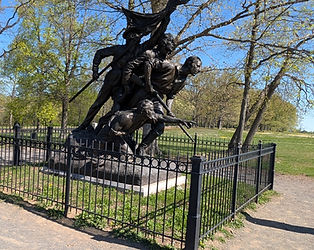
Louisiana State Memorial
The Louisiana State Memorial, dedicated in 1971, honors soldiers from Louisiana who fought for the Confederate Army. The bronze sculpture features three infantrymen: one wounded, one carrying the Louisiana state flag, and one encouraging them onward. Located near Seminary Ridge, it commemorates the Louisiana troops' assaults on Union positions during the battle, including Pickett's Charge, and reflects the human cost of war.